NEW


Ask yourself, whose social care is it anyway?

Blog by Sinead Mchugh-Hicks, Executive Director of support at Advance Housing & Support
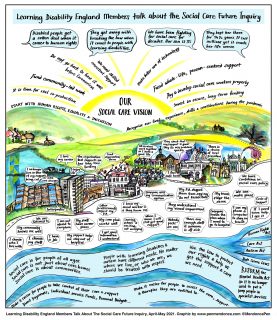
This is part of the Future of Social Care series of members’ thoughts and views.
Find out more about Learning Disability England’s work on the future of social care here
“I joined Advance in December 2020 but have worked in the sector for many years.
Joining an organisation in the middle of a global pandemic was daunting and challenging – but what I have seen in the care and support provided by Advance has really inspired me.

This week I visited people we support in Essex.
Having not had the opportunity to get out and about very much due to the timing of my joining, I felt nourished by spending time with people and the interactions I observed, the stories I was told and the compassion and respect that was evident between the people I met and their support workers.

However, there was something that left me feeling a little sad, the mask.
I have worked in social care since 2002 and I have never worn a uniform. Even then, we tried to be discreet about our ID badges and our paid roles in people’s lives, we tried to be human about our work.
As a Support Worker, part of my role was to help people be a part of their community, not to draw attention to their disability but their ability, their contribution.
Whilst visiting people this week, there was a clearly visible difference between Customers and Colleagues – those wearing a mask and those not. The mask serving as a physical reminder, a uniform, ‘I am paid to be here, you are vulnerable’.

I have spent years explaining that most of the people we support are not ill, they are not patients, they are people, who need a little support with some aspects of their lives but now, we risk taking big steps backwards.
If you have a learning disability or mental health need you are vulnerable, you need a bit more cotton wool than everyone else, you can’t take the same risks as others, government guidance makes decisions about what happens in your home.
We still await the Government’s detailed proposal to reform social care. The Health and Social Care white paper and the National Disability Strategy failed to deliver on this but whilst we continue to wait, people’s lives, the only life they have, is on hold.

So, what can we do instead of waiting for the reform we wish to see?
We need to be it, lead it, make it happen in our everyday lives, our interactions, our language, culture and dare I say policies.
Let’s stop talking about co-production and ensure it’s just what we do, that everything is done with respect, driven by the individual, for the individual, enable them to control their own care and support no matter how it is funded or where they live.
Make sure all services are working together and hold them (and ourselves) to account when they are not.
Ask yourself, who’s social care is it anyway?”
Sinead Mchugh-Hicks is Executive Director of support at Advance Housing & Support providing services across England.
Being part of the future of social care
In April 2021, Learning Disability England members got together to talk about the Social Care Future Inquiry.
The members in that meeting were self advocates, family members and paid supporters.

Our members are using what’s happened in their lives and their views to help improve social care for people with a learning disability.

Our members believe it’s important they have a say about the social care they and other people with a learning disability receive in the future.

This is because good social care can help people with a learning disability do what they want and need to do.
Some members having been blogging about their work and their experiences.
This is to share ideas as part of the work members are doing on the future of social care.

Watch Mary’s video about good support here
Read the blog from John Casson at L’Arche and watch his video with Rebecca Tucker here
Read the blog from Dame Philippa Russell here
Read the blog from Sinead McHugh-Hicks at Advance here
Read the blog from the Task Force Advisory Group Co Chairs Alex, Trevor and Rachel here

Changing social care as part of Social Care Future
One of the ways our members get to talk about social care is by being involved with Social Care Future.
It is a growing group of people across the country who want to improve social care for everyone.

In November 2018, some of our members attended a Social Care Future event in York.
At the event, Gary and Sam from Learning Disability England hosted a group session called Including Everyone.
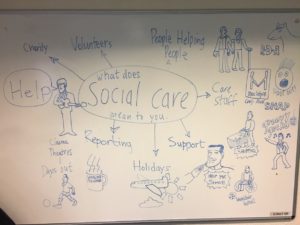
During the session, our members talked about what matters to them in their lives.
They also talked about how care staff and other people can make their life better.

People from other organisations also talked about the same topics.
These organisations included New Prospects Association, Alzheimer’s Society and Local Area Coordination.
Some of our members also attended another Social Care Future event in Manchester in April 2019.
At this event, a wide range of people talked about how social care could be changed for the better.

People at the event also talked about how we should describe the social care we want for everyone.

Changing social care through our Think Tanks

Learning Disability England Think Tanks give members the chance to talk about a topic or issue that is important to them.

Our first Think Tank in July 2019 focused on social care for people with a learning disability.
Members who took part in the Think Tank told us what good social care means to them and how it can help them live a better life.
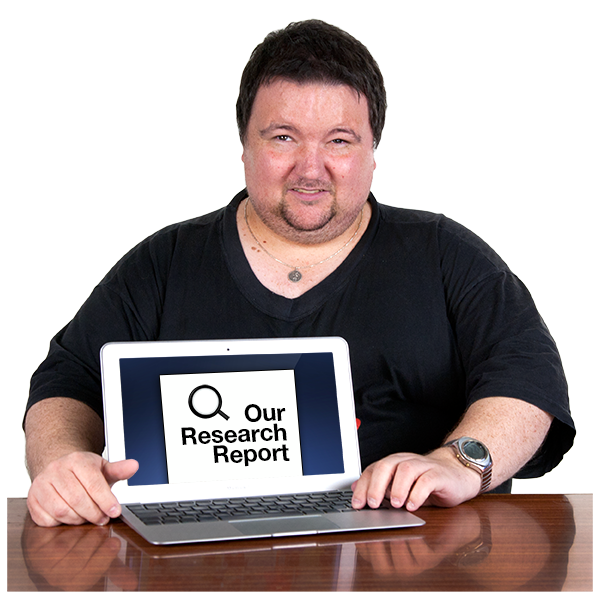
After hearing what everyone had to say, we collected their thoughts and wrote this report about social care.
“People making a difference – not out of sight”
Vlog by Gary Bourlet on why we must recognize the achievements of people with learning disabilities, featuring Scott Watkins BEM and Dr Mark Brookes BME.
November Update and the latest restrictions

On Saturday, the Prime Minister told us all that there will be national restrictions coming into effect from this Thursday, 5 November.
They will last for at least a month.
Task Force Advisory Group and social care reform

Blog from the Task Force Advisory Group Co Chairs Alex Fox, Rachel Moody and Trevor Wright
This blog is part of our series on the future of social care.
If you have heard politicians debating social care in the last few weeks, you would think that social care is just for older people and that the main problem with it is money.
Many people with learning disabilities and autistic people know that neither of these things are true.
Social care is also about helping people of all ages to live well, when they need extra support to do ordinary things like live independently, take part in community activities, or go to work.
It is true that councils are not given enough money to run good social care services for everyone who needs them.
But even many of those services which do have enough money need to change to fit with how people want to live their lives.

What was the Task Force Advisory Group?
People with learning disabilities and autistic people and people working in organisations and councils came together during the pandemic to help the government to understand and respond to the impacts of COVID-19 on people and families.
The group was co-chaired by Rachel Moody and Trevor Wright, both Experts by Experience and Alex Fox of the charity Shared Lives Plus.
We fed our ideas back to the then social care Minister Helen Whately MP and other people in the government and in councils. We also shared what we’d learned about making our group more accessible, which it wasn’t to begin with.
Read the response from the Co Chairs to the Task Force here (easy read)

Recommendations
We did make recommendations about money and equipment for social care provider organisations which had many problems when the pandemic started with getting and affording PPE, tests and the money and support they needed to work in ways that kept people safe from infection.
We also wanted the government to do more to make sure that accessible information about the pandemic was produced in time, and to work with local user-led and community groups to help people find their way to and through that information.
People themselves need to be involved in co-producing accessible information and all kinds of organisations and services, not just social care ones, need to take it much more seriously so that people with learning disabilities and autistic people don’t end up confused, frightened or unable to do ordinary things when rules change.
Many day support services stopped during the pandemic. Some don’t look like they are going to open again. This has left some people very isolated and some families struggling to cope.
We recommended that councils do more to find out who is struggling, including people and families who didn’t get any social care before the pandemic but might need it now.
No councils should assume that someone doesn’t need a service just because they appear to have ‘managed’ without. Any decisions about changes to support need to be made with people and not rushed.
We heard that loneliness and isolation has got worse through the lockdowns.
We recommended a government funding plan for voluntary, community and social enterprise (VCSE) organisations to support funding people and families who may be at risk of crisis.

The future
There is a need for investment in community building in the short term, through the VCSE sector, and for the long-term social care reform plan to have a strong focus on communities, inclusion and the role of the VCSE sector.
It’s good that there is now a national autism strategy. We called for a whole-life learning disability strategy too.
You will see that these ideas are about much more than social care services and how to pay for them: they are about people being able to live good lives!
Visiting during COVID

The issue about being able to visit loved ones – or to have visitors and get out and about to see friends and family – is taxing and vexing all of us.
This is even more true now a further lockdown has been announced in England from this Thursday.
Our Key Priorities

What we work on is developed by the Representative Body after consulting our members.
You can see how the priorities were decided here

Members and the Representative Body have said our work should focus on developing the work around Good Lives.
We do this by:

Giving information to and supporting the members of Learning Disability England.

Representing what matters to members so that we can change attitudes and influence policy.

Supporting good practice and creating solutions together.

Campaigning on issues that matter to people with learning disabilities.

Working alongside our partners on projects and research.
“We must move forward, but never, never forget those who got us here in the first place”
Blog by Gary Bourlet on remembering people with a learning disability who we have lost.
Social Care Future: What members said
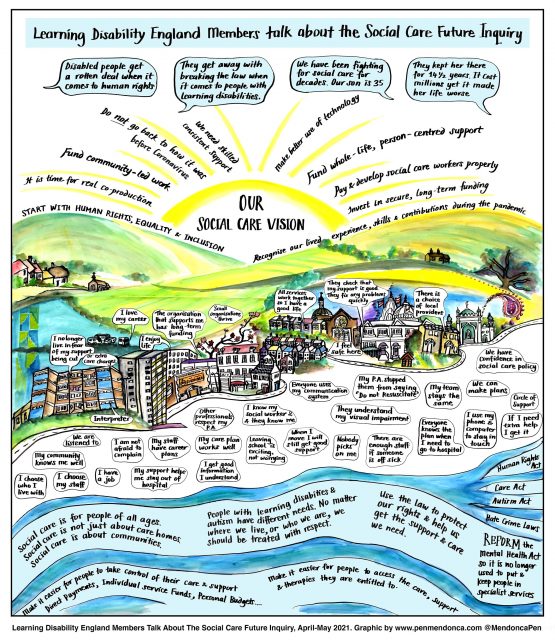
In April 2021, Learning Disability England members got together to talk about the Social Care Future Inquiry.
The members in that meeting were self advocates, family members and paid supporters.
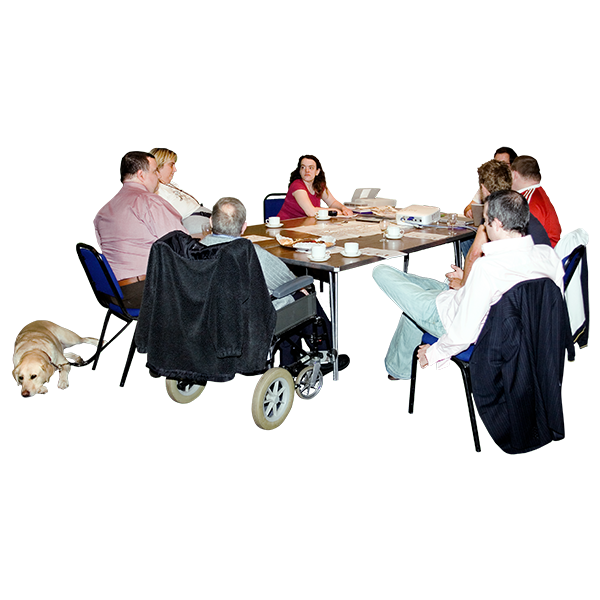
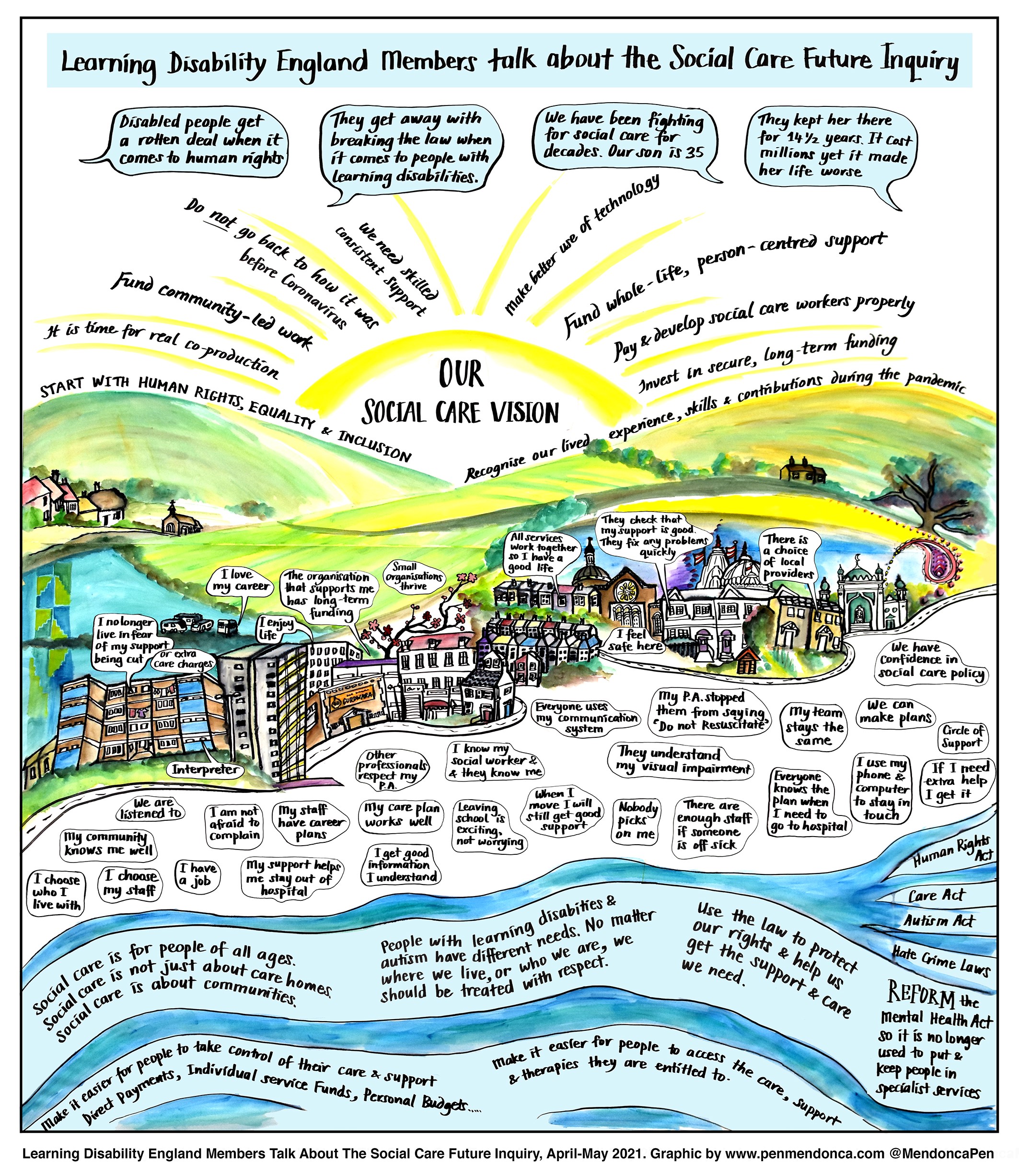
The people at the meeting talked about what they want their social care to be like (Our Social Care Vision).

They talked about the things that need to change.

They agreed the things people would say about their lives if support worked how we want it to.

And the things people would notice if social care was always really great.

The members also talked about what all kinds of members, including organisation workers, can say if social care works well.
You can read everything the members said in the easy read report here.
This report has been sent to the Social Care Future team as part of the Inquiry.
You can also download the graphic, drawn by Pen Mendonca, here
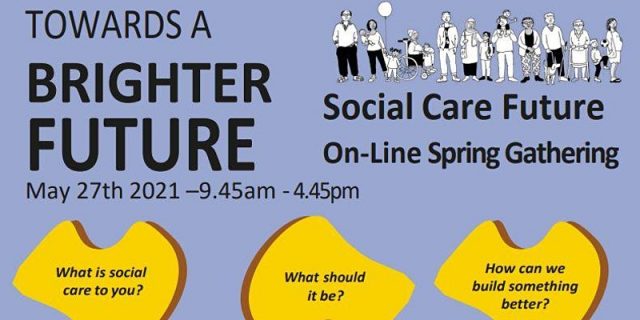
On May 27th Social Care Future held their Spring Gathering.
It was called Towards a Brighter Future.
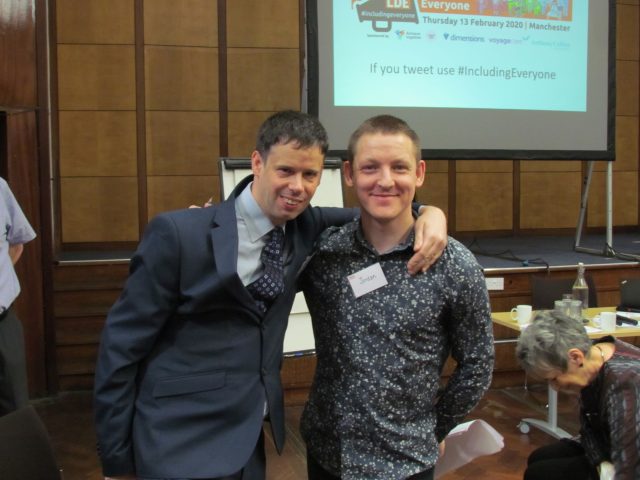
Learning Disability England members ran a session at the gathering lead by Scott Watkins and Jordan Smith.
It shared the key themes that emerged from the inquiry and next steps in building the movement.

Members are sharing their personal experiences and views in a series of guest blogs.


If any members want to get involved or feedback on our work on social care please contact Sam Clark by emailing samantha.clark@ldengland.org.uk.